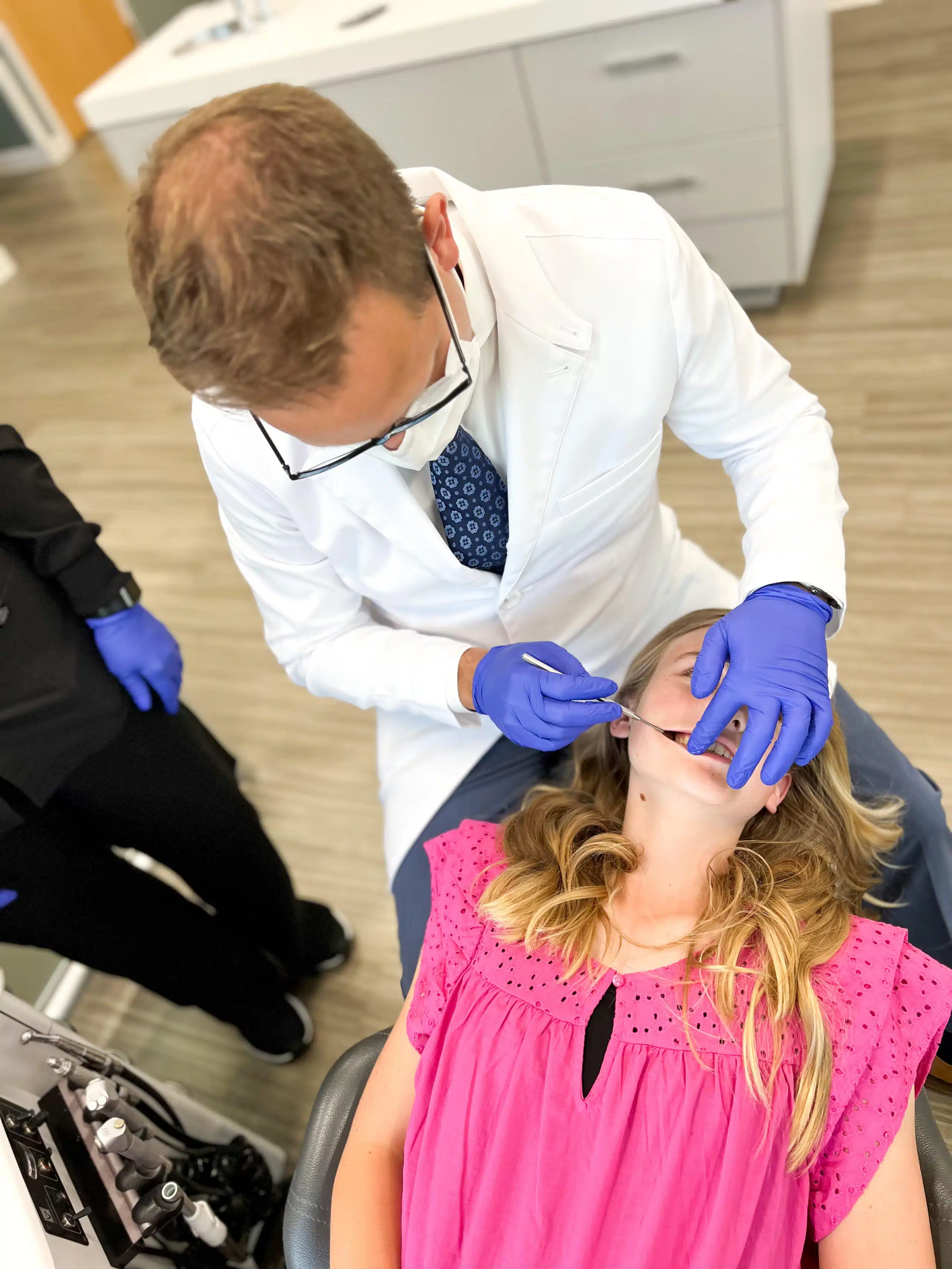
Jaw surgery is considered when a bite problem comes from the size or position of the jaws rather than the teeth. Dr. Joel Johnson evaluates whether braces alone can correct it, and plans the orthodontic sequencing with an oral and maxillofacial surgeon.
What makes a bite problem skeletal instead of dental?
Teeth-only problems
Some bite problems are primarily about tooth position. Orthodontic treatment can be planned around the teeth after Dr. Johnson evaluates your bite and growth status.
Jaw-position problems
A skeletal discrepancy involves the size or position of the jaws. The O·M·I surgical orthodontics page explains that treatment may combine orthodontics with jaw surgery by an oral and maxillofacial surgeon.
How the difference shows up in the chair
The distinction is not cosmetic hair-splitting; it decides what treatment can achieve. A lower jaw that sits well behind or ahead of the upper, an open bite where the front teeth never meet, or a marked asymmetry between the two sides of the jaw are presentations Dr. Johnson assesses for a skeletal cause first, because moving teeth cannot relocate a jaw. Plenty of patients arrive convinced surgery is inevitable and turn out to be treatable with orthodontics alone. Others have spent years being told to live with something that is correctable. Imaging and records settle it, not appearance alone.
Why function usually drives the decision
The reason a combined plan gets recommended is rarely how a bite looks. It is chewing that does not work, teeth wearing unevenly because the bite loads them wrong, jaw joint symptoms, or breathing and airway concerns flagged by a physician or dentist. When those functional findings line up with a skeletal discrepancy on imaging, surgery enters the conversation. When they do not, it usually stays out of it.
How does growth affect the decision?
Growing patients
Growth status is the dividing line in planning. Early orthodontic evaluations from age 7 can identify developing concerns and support growth guidance, space maintenance, habit correction, and development monitoring. Read about early orthodontic treatment.
Adults
When growth is complete, the team evaluates whether the jaw relationship requires combined treatment. No single symptom decides candidacy, and no article can replace an individual examination.
What does combined treatment look like, step by step?
Orthodontics before surgery
Dr. Johnson plans the orthodontic sequencing with the oral and maxillofacial surgeon. The steps and timing depend on the individual plan.
Before any of that, there is a diagnostic phase: records, imaging and an honest assessment of whether the discrepancy is actually skeletal. If it is, Dr. Johnson and your surgeon agree on a plan and a sequence before treatment starts. Orthodontic treatment then usually begins first, to move the teeth into the positions that let the jaws be repositioned into a bite that works. That is the part patients find counterintuitive — the bite can look worse partway through the orthodontic phase, because the teeth are being set up for where the jaws are going, not for where they are now.
The surgical phase with the oral surgeon
The oral and maxillofacial surgeon performs the jaw surgery when it is part of the plan. O·M·I does not name a specific surgeon or hospital on the published page.
Surgery happens under the surgeon’s care, on the surgeon’s timeline, with recovery instructions that come from them rather than from the orthodontic office. Ask your surgeon directly about the procedure, anesthesia, hospital time and the recovery you should plan for at work or school; those answers belong to the person performing it and are specific to your case.
Finishing and retention
After the surgical phase, orthodontic finishing and retention are planned. Review retainer care for the published post-treatment information.
Finishing is where the result is actually made. Once the jaws are in position, orthodontic treatment continues to settle the bite and refine tooth contacts, and then retention follows indefinitely — teeth drift after every method of straightening them, combined cases included. Combined treatment is longer and more coordinated than routine orthodontics, generally measured in years rather than months, and anyone quoting you a duration before seeing your imaging is guessing.
| Signs that point to teeth only | Signs that may point to the jaws | Who evaluates it |
|---|---|---|
| Tooth-position concern | Skeletal discrepancy | Dr. Johnson with the surgical team |
| Orthodontic planning | Orthodontics plus possible jaw surgery | Orthodontist and oral/maxillofacial surgeon |
Who is on the team?
What the oral and maxillofacial surgeon does
The surgeon repositions the jaws. That is their domain: the surgical plan, the procedure itself, your anesthesia and your recovery. They also confirm, from their own examination and imaging, whether the surgical component is warranted at all.
What your orthodontist plans
Dr. Joel Johnson plans the orthodontic sequencing. The oral and maxillofacial surgeon performs the surgery when surgery is indicated. Learn more about Dr. Joel Johnson and surgical orthodontics.
Why the orthodontic side matters as much as the surgery
The surgeon moves the jaws; the orthodontist decides where the teeth need to be for that movement to produce a bite that functions afterwards. Get that wrong and a technically successful surgery still leaves a bite that does not work. Dr. Johnson trained in orthodontics at the University of Michigan, lectures nationally at the AAO and on CBCT imaging, and serves as an adjunct clinical professor in Michigan’s orthodontic department — relevant here because combined cases lean heavily on reading three-dimensional imaging correctly before a plan is committed to.
How do you get a straight answer about your own bite?
What to ask at the consultation
Ask whether the finding is skeletal or dental, and ask to be shown it on your own imaging rather than on a diagram. Ask what orthodontics alone could achieve and what it could not. Ask what the sequence would be and who does which part. If growth is still in play for a child, ask what is gained by intervening now versus monitoring — for a growing patient, jaw position can sometimes be influenced while the bones are still developing, which is the whole argument behind early evaluation.
What insurance you should check first
Combined cases can touch both medical and dental coverage, and the two are written differently — orthodontic benefits typically carry a lifetime maximum, while the surgical component is often assessed on medical criteria by a different insurer or a different part of the same policy. O·M·I offers a complimentary benefits check and assists with claims and documentation on the orthodontic side; the surgeon’s office handles the surgical claim. Start both checks early, because documentation requirements, not clinical readiness, are what usually delay these cases.
Frequently asked questions about jaw surgery and braces
Will braces alone fix an underbite?
It depends on whether the underbite is dental or skeletal. An evaluation is needed.
Does every severe bite need surgery?
No. Surgery is considered based on the individual jaw relationship and treatment plan.
How long does the orthodontic phase before surgery take?
It depends on the individual plan. O·M·I does not publish a universal average.
Does insurance cover jaw surgery?
Medical and dental coverage differ. O·M·I offers a complimentary benefits check and assists with documentation. Schedule a complimentary consultation to discuss your plan.
Surgical orthodontics requires coordinated planning. Growth status, jaw position, and the sequence agreed by the orthodontic and surgical teams guide the plan. In a complimentary consultation, the O·M·I team reviews your individual plan, answers questions, and explains which details still need confirmation. The right choice depends on your goals, clinical findings, and the plan discussed with the team; this article does not promise a price, timeline, outcome, or coverage result.
Dr. Johnson will also explain where traditional braces fit into a combined plan, and what each phase is meant to accomplish.